The creative industry offers many career opportunities for students interested in visual communication, digital content, animation, advertising, branding, and multimedia production. As businesses increasingly depend on digital platforms to communicate with their audiences, the demand for creative skills has expanded across industries such as advertising, education, entertainment, e-commerce, marketing, and media production.
For students planning to enter this field, one common question is whether to choose graphic design or multimedia. Both areas involve creativity, visual communication, and digital tools, but they differ in their focus, learning requirements, and professional applications.
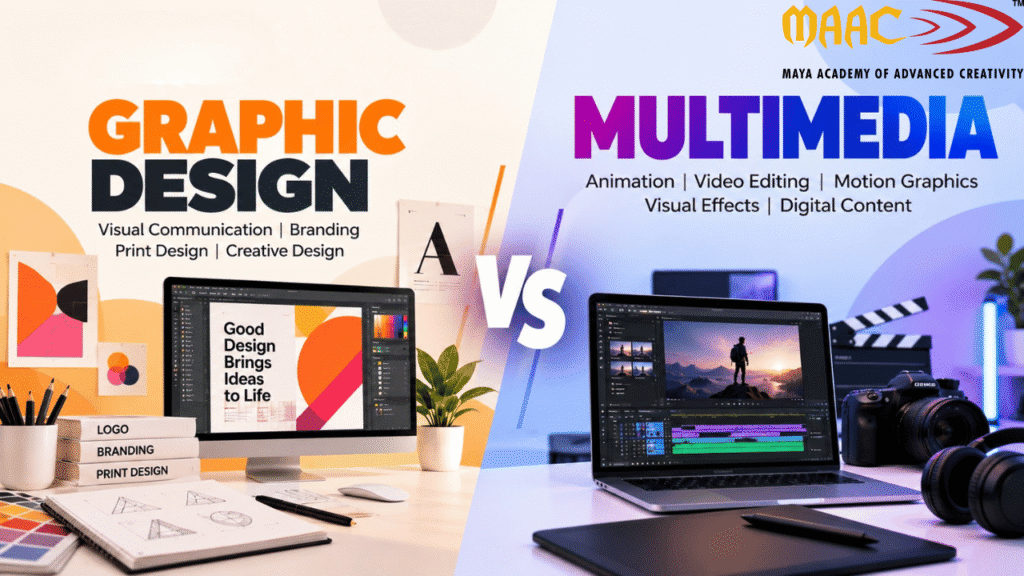
Graphic design primarily focuses on communicating ideas through visual elements such as typography, colours, images, illustrations, layouts, and branding. Multimedia covers a broader range of creative formats, including graphic design, motion graphics, animation, video editing, audio, and interactive digital content, depending on the course curriculum.
Choosing the right learning path depends on your interests, career goals, preferred working style, and the kind of projects you want to create.
A graphic design and multimedia course can be a suitable option for students who want to explore multiple creative disciplines and develop a broader understanding of digital media production. It can introduce learners to graphic design fundamentals while helping them explore animation, video, and other multimedia workflows.
This guide explains the differences between graphic design and multimedia, the skills involved in each field, software used by designers, career opportunities, portfolio development, and how to decide which course is right for you in 2026.
Graphic design is the process of communicating information, ideas, and messages through visual elements. Designers combine typography, colour, imagery, shapes, and composition to create designs that are clear, attractive, and appropriate for a specific audience.
The objective is not simply to make something look good. A graphic designer must understand the purpose of the communication and organize visual information so that the audience can understand it.
For example, a company launching a new product may need a logo, packaging, social media advertisements, brochures, posters, and promotional banners. A graphic designer helps develop these visual materials while maintaining the company’s identity and communication style.
Graphic design is used across both print and digital media.
Common graphic design applications include:
Logo design and brand identity
Posters and flyers
Brochures and catalogues
Social media creatives
Digital advertisements
Packaging design
Typography-based artwork
Infographics
Marketing materials
Website graphics
Students interested in visual composition, typography, colour combinations, branding, and static design may find graphic design an appealing career direction.
Multimedia combines different forms of content to communicate information or tell a story. Depending on the specialization, multimedia production may involve images, graphics, animation, video, audio, motion graphics, and interactive elements.
For example, a digital advertising campaign might include a poster, an animated advertisement, a promotional video, and short-form social media content. These materials can be developed using a combination of graphic design and multimedia production skills.
Multimedia is used in entertainment, advertising, digital marketing, education, gaming, corporate communication, and online content creation.
Common multimedia applications include:
Motion graphics
Video editing
2D animation
3D animation, depending on specialization
Promotional videos
Animated advertisements
Explainer videos
Digital presentations
Interactive media
Visual storytelling
A multimedia course may introduce students to multiple creative disciplines, although the exact subjects depend on the institution and course structure.
Students who enjoy combining images, movement, sound, storytelling, and visual effects may prefer multimedia-oriented training.
Although graphic design and multimedia overlap, their primary focus differs.
| Feature | Graphic Design | Multimedia |
|---|---|---|
| Main focus | Visual communication and design | Multiple digital media formats |
| Typical output | Logos, posters, brochures, graphics | Videos, animation, motion graphics, digital content |
| Core skills | Typography, colour, layout, branding | Visual design, editing, animation, storytelling |
| Movement | Usually static, though designs can be adapted for motion | Often includes movement, video, or interactive elements |
| Common tools | Adobe Illustrator, Photoshop, InDesign | Photoshop, Illustrator, Premiere Pro, After Effects, and other tools depending on specialization |
| Suitable interests | Branding, layouts, illustrations, visual identity | Animation, video, motion, digital storytelling |
| Portfolio examples | Logos, campaigns, packaging, brochures | Videos, animated sequences, motion graphics, multimedia projects |
These are general distinctions rather than strict boundaries. Graphic designers can specialize in motion design, and multimedia artists often need strong graphic design skills.
Both graphic design and multimedia can be suitable for beginners. The better choice depends on what you want to create.
Graphic design can be a natural starting point if you want to understand the fundamentals of visual communication. You can begin with simple layouts, colour combinations, typography, and image composition before progressing to more complex projects.
Multimedia can be a good choice if you want to explore several creative formats, particularly animation, video editing, and motion graphics.
Consider your preferred activities:
Do you enjoy designing posters, logos, and social media creatives? Consider graphic design.
Do you enjoy editing videos and creating animated sequences? Consider multimedia.
Do you want to explore both static and moving visuals? Look for a multimedia program with strong graphic design fundamentals.
Are you unsure about your specialization? Start by exploring introductory design projects before making a decision.
A good beginner course should provide structured lessons, guided practice, and practical assignments rather than focusing exclusively on software demonstrations.
Graphic designers use different applications depending on the type of project.
Photoshop is primarily used for image editing, retouching, compositing, and raster-based artwork.
Designers can use it to create advertising graphics, photo manipulations, promotional creatives, and digital artwork.
Illustrator is primarily used for vector graphics.
It is useful for logo design, icons, illustrations, typography-based graphics, and brand identity elements.
InDesign is designed for page layout and publishing.
It is useful for brochures, magazines, books, catalogues, reports, and other multi-page documents.
Some designers also use Canva and similar tools for quick layouts, social media content, and template-based design workflows.
The right software depends on the project. Professional graphic designers often use multiple applications rather than relying on a single tool.
Multimedia software depends on the subjects covered in the course.
Premiere Pro is used for video editing. It allows editors to arrange footage, trim clips, add transitions, work with audio, and assemble complete video projects.
After Effects is commonly used for motion graphics, animation, compositing, and visual effects.
It can be used to animate text, create logo reveals, develop promotional sequences, and add motion to visual elements.
Photoshop can support multimedia projects by helping designers prepare images, thumbnails, backgrounds, and other visual assets.
Depending on the syllabus, multimedia programs may introduce tools for 3D modelling, animation, rendering, or visual effects.
Students should confirm which software versions and subjects are included before choosing a course.
A graphic design course should teach more than the operation of design software. Students also need to understand the principles that make a design effective.
Colour influences visual emphasis, mood, and brand recognition. Students learn how to choose colour combinations that support the design objective.
Typography involves selecting and arranging typefaces. It includes font pairing, spacing, alignment, readability, and hierarchy.
Layout determines how text, images, and other elements are arranged. Good composition helps the viewer understand the message quickly.
Visual hierarchy guides attention toward the most important information first. Size, contrast, colour, spacing, and placement all contribute to it.
Branding projects require consistency across logos, colours, typography, packaging, and marketing materials.
Graphic designers need to interpret briefs, understand audiences, explore concepts, and create visual solutions that meet specific requirements.
These skills can help students create designs that are both visually appealing and purposeful.
Multimedia develops a different but overlapping set of skills.
Students may learn to organize footage, edit sequences, add transitions, balance audio, and export videos for different platforms.
Motion graphics combine graphic elements with movement. Examples include animated titles, logo animations, promotional videos, and social media advertisements.
Animation involves concepts such as timing, spacing, movement, anticipation, and visual continuity.
Multimedia projects often require a clear beginning, middle, and end. Students learn to communicate a message through a sequence of visuals and sounds.
Depending on the course, students may learn audio synchronization, basic sound editing, video formats, and export settings.
Advanced multimedia programs may introduce compositing, effects, and techniques for combining multiple visual elements.
These skills are particularly useful for students who want to create dynamic content rather than only static designs.
Graphic design can lead to a range of entry-level and specialized roles.
Creates visual materials for businesses, agencies, educational institutions, and other organizations.
Develops logo concepts and visual marks for companies and products.
Creates visual identity systems, including logos, colours, typography, and supporting brand assets.
Produces platform-specific graphics for marketing campaigns, announcements, promotions, and content calendars.
Creates visual designs for product packaging and labels.
Develops campaign creatives for print and digital advertising.
Works on brochures, magazines, catalogues, reports, and other structured documents.
Provides design services directly to clients and businesses.
Career progression depends on the quality of your work, practical experience, communication skills, specialization, and ability to meet client requirements.
Multimedia can lead to several roles involving video, animation, and visual storytelling.
Edits video footage into complete videos for advertising, social media, education, entertainment, and corporate communication.
Creates animated text, graphics, transitions, and visual sequences.
Creates two-dimensional animated characters, scenes, and visual elements.
Combines different media formats to produce digital communication materials.
Plans and produces video content for businesses, organizations, and digital platforms.
Works on compositing and effects for film, television, advertising, or other visual productions, depending on specialization.
Works on animation projects according to the relevant skills and production pipeline.
Provides editing and post-production services to clients.
Specialized roles may require additional training, advanced software knowledge, and a strong portfolio.
Both fields can offer career opportunities. Neither guarantees employment simply because a student completes a course.
Graphic design is relevant wherever organizations need branding, advertising, visual communication, and marketing materials.
Multimedia is relevant wherever organizations need video, animation, motion graphics, and audiovisual content.
The choice should depend on the kind of work you want to perform.
Graphic design may suit you if you prefer:
Creating logos and brand identities
Designing advertisements
Developing layouts
Working with typography
Creating visual assets for businesses
Multimedia may suit you if you prefer:
Editing videos
Creating animated graphics
Developing visual stories
Working with movement and timing
Producing promotional content
Students who enjoy both areas can consider a program that combines graphic design with multimedia fundamentals.
The most important factors are practical ability, portfolio quality, consistency, communication, and continued learning.
Salary depends on several factors, including location, experience, portfolio quality, company size, specialization, and technical ability.
Entry-level salaries can vary considerably between employers, so students should avoid selecting a course based only on advertised salary promises.
For a more realistic assessment, review current job listings in your preferred city and compare the required skills with your training plan.
Graphic design roles may prioritize branding, layout, typography, and advertising design. Multimedia roles may prioritize video editing, motion graphics, animation, or other production skills.
As professionals gain experience, they may specialize in areas such as brand identity, art direction, motion design, or advanced animation.
Freelance earnings can vary even more because they depend on client demand, project pricing, workload, and business development.
When comparing a graphic design and multimedia course, check whether the curriculum covers the subjects that match your career goals.
A useful graphic design syllabus may include:
Design fundamentals
Colour theory
Typography
Photoshop
Illustrator
InDesign
Logo design
Branding
Layout design
Social media creatives
Print design
Portfolio development
A multimedia-focused syllabus may include:
Design fundamentals
Image preparation
Video editing
Premiere Pro
After Effects
Motion graphics
Basic animation
Audio and video workflows
Promotional video projects
Portfolio development
A broader DGWA program may combine several of these subjects. However, course names are not standardized across institutions, so confirm the exact syllabus, practical hours, project work, and software coverage with the institute.
Projects allow students to apply their learning to realistic design problems.
Create a fictional brand and develop its logo, colour palette, typography, and supporting graphics.
Design a coordinated set of social media posts for a product launch or promotional campaign.
Create a multi-page brochure for a business, educational institution, or service provider.
Develop packaging artwork for a fictional product, including brand elements and product information.
Create a poster with a clear headline, strong visual hierarchy, supporting information, and a call to action.
These projects demonstrate a student’s understanding of design principles and ability to apply software skills.
Multimedia students should build a portfolio that demonstrates timing, editing, movement, and storytelling.
Create a short promotional video for a product, service, or business.
Develop a short logo animation using motion graphics techniques.
Animate text to communicate a short message or brand statement.
Edit a vertical video with suitable pacing, transitions, text, and audio.
Create a short video that explains a product, service, or process using visuals and narration where appropriate.
These projects help demonstrate practical production skills rather than software familiarity alone.
Yes. Learning both can be useful if you want to work across different types of visual communication.
For example, a marketing campaign may require:
A logo
Social media graphics
A promotional poster
A product brochure
An animated advertisement
A short promotional video
Graphic design skills can help you create the static assets, while multimedia skills can help you animate and edit content.
However, trying to master every creative discipline at once can be challenging. It is often more effective to build strong fundamentals, choose a primary specialization, and gradually expand into related areas.
A possible learning path is:
Design Fundamentals → Graphic Design → Video Editing → Motion Graphics → Portfolio Specialization
Students interested primarily in animation may follow a different path depending on their goals.
If you are searching for a graphic design or multimedia course in Hyderabad, compare institutes carefully before enrolling.
Check which subjects and applications are taught, and whether they align with your career goals.
Find out how much time is dedicated to projects, assignments, and guided practice.
Where available, examine student work to understand the practical outcomes of the course.
Ask how students receive feedback and whether they can get help with project revisions.
A course should help students create original work that demonstrates their skills.
Confirm duration, fees, eligibility, software access, certificate details, and any placement assistance offered. Ask for written details about any employment or placement claims.
Resume preparation, interview practice, portfolio reviews, and project presentation can support the transition from learning to job applications.
Two programs with similar names may have very different curricula. Review the actual subjects.
Knowing which buttons to click is not the same as understanding visual communication.
Tutorials are useful for practice, but portfolios should demonstrate your own concepts and problem-solving.
Employers and clients often want to see evidence of what you can create.
Focus on fundamentals and build toward a specialization.
Training can build skills, but career outcomes also depend on practice, portfolio quality, communication, and market conditions.
Use your interests and goals to guide your decision.
Choose graphic design if you enjoy static visual communication, branding, typography, layout design, and advertising creatives.
Choose multimedia if you enjoy video editing, animation, motion graphics, and audiovisual storytelling.
Consider a combined program if you want to explore both fields and the curriculum provides adequate practical training in each.
Before enrolling, ask to see the complete syllabus and examples of student projects. This will help you understand what you will learn and what you should be able to create by the end of the course.
Graphic design primarily focuses on static visual communication, including logos, posters, layouts, and branding. Multimedia can combine graphics with video, animation, audio, and other media formats.
Neither is universally better. Graphic design may suit students interested in branding and visual layouts, while multimedia may suit those interested in animation, video editing, and motion graphics.
Yes. Beginners can start with design fundamentals and gradually learn the relevant software through guided practice and projects.
Common tools include Adobe Photoshop, Adobe Illustrator, and Adobe InDesign. Other tools may also be used depending on the workflow.
Depending on the specialization, students may learn Adobe Premiere Pro, Adobe After Effects, Photoshop, and applications for animation or 3D production.
A course can help you develop relevant skills, but employment depends on your portfolio, practical ability, communication, experience, and the requirements of employers.
A multimedia program that includes substantial video-editing practice can be a suitable choice. Check the syllabus to confirm the depth of training.
Yes. Graphic design skills are useful for creating advertisements, social media graphics, campaign visuals, brand assets, and other marketing materials.
Yes. Potential services include logo design, branding, social media creatives, brochures, posters, and packaging. Success depends on design quality, client communication, pricing, and consistent delivery.
Graphic design portfolios can include branding, logos, brochures, posters, and social media campaigns. Multimedia portfolios can include edited videos, motion graphics, animations, and promotional content.