If you are interested in video games, 3D characters, interactive worlds, animation, storytelling, or real-time graphics, game design can be an exciting career path in 2026. The modern gaming industry is no longer limited to people who know programming alone. Game production involves designers, 3D artists, animators, level designers, UI/UX designers, technical artists, environment artists, and many other creative and technical professionals.
For students looking for a game design course in Hyderabad, the city offers access to training programs covering 3D modeling, game art, animation, UI design, real-time 3D, Unity, Unreal Engine, and interactive experiences. Programs such as ADIDG Plus are designed around gaming, 3D design, interactive media, and real-time workflows.
This guide explains what game design involves, what skills students can learn, the software commonly used in the industry, possible career roles, portfolio requirements, and how to prepare for a career in game design in 2026.
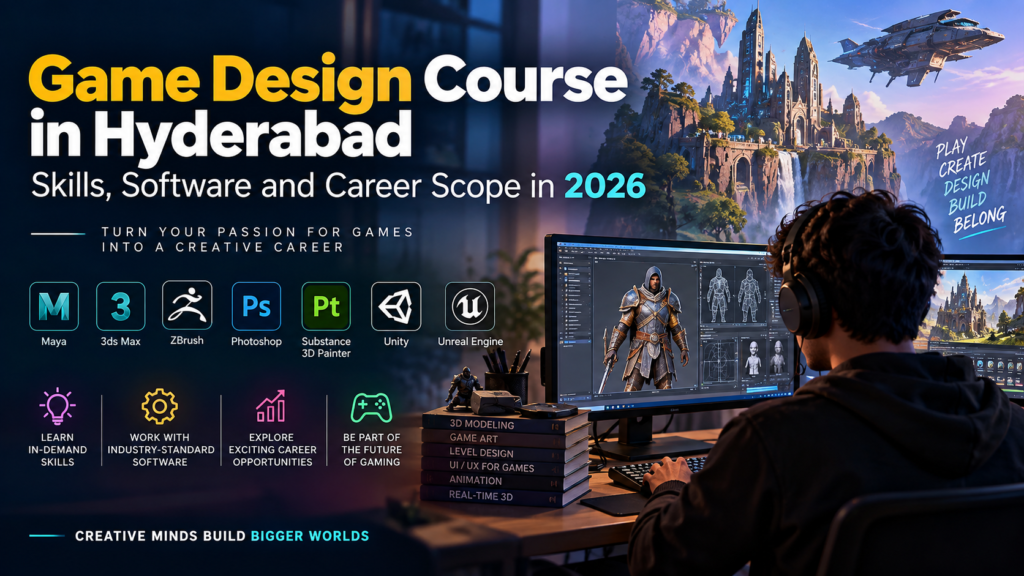
Game design is the process of planning and creating the experience that players interact with inside a game.
It involves much more than creating attractive graphics. A game designer may work on:
A complete game is usually created through collaboration between different specialists. Artists create visual assets, designers plan gameplay and levels, animators bring characters to life, programmers implement functionality, and technical artists help connect creative assets with the technical requirements of the game engine.
Modern game-design education therefore combines creative thinking, visual design, 3D production, animation, interactive design and real-time technology.
Hyderabad has developed into an important technology and media hub, making it a relevant location for students interested in creative technology careers.
The gaming field is also expanding into areas beyond traditional PC and mobile games. Game-development skills are increasingly relevant to:
Recent industry-oriented course structures reflect this wider ecosystem. For example, MAAC’s current game-design programs include game art, UI/UX, real-time rendering, Unity, Unreal Engine and interactive 3D workflows.
This means students don’t necessarily have to think of game design as a single career. The skills can be developed toward several different specializations.
A structured game design course in Hyderabad can introduce students to the complete game-creation pipeline.
The exact curriculum varies between institutes and programs, but a comprehensive program can include the following areas.
Before creating complex 3D game assets, students need to understand fundamental visual principles.
These can include:
These fundamentals help artists create assets that look appropriate within a game environment rather than simply producing isolated images.
2D design is still important even in a highly 3D-focused gaming environment.
Students may work on:
Understanding 2D design can also help a student communicate ideas before creating the final 3D asset.
3D modeling is one of the most important skills in game art.
Students learn how to create objects and characters in three-dimensional space.
Typical projects may include:
The process can involve creating a basic shape first and then adding details, topology and surface information.
Characters are often central to games, so character development is an important specialization.
Students can learn about:
A character is not finished simply because the model looks good. It also needs to work correctly when animated inside a game engine.
Environment artists create the worlds in which players explore and interact.
Examples include:
Environment design combines modeling, texturing, lighting, composition and optimization.
A 3D model needs surface information to appear realistic or visually consistent.
Students can learn about:
Substance 3D Painter and related texturing workflows are included in several current game-art programs.
One of the most common questions students ask before joining a game design course in Hyderabad is:
“Which software will I learn?”
The answer depends on the specialization and institute, but modern game-design education can involve a combination of modeling, texturing, animation, game engines and creative tools.
Maya is widely used for 3D modeling, rigging and animation.
Students may use it to create:
Current game-art programs list Maya among the software used for 3D production.
3ds Max is another major 3D software package used in modeling and visualization workflows.
It can be useful for:
Some game-design programs include 3ds Max alongside Maya and other tools.
ZBrush is primarily associated with digital sculpting.
It can be used to create highly detailed:
For students interested in character art and high-detail models, sculpting can become an important part of the workflow.
Photoshop can support many areas of game production.
It can be used for:
Although game production has become increasingly 3D and real-time, 2D design skills remain valuable.
Substance 3D Painter is commonly used for creating and applying detailed materials and textures to 3D models.
It is particularly useful for producing game-ready assets with realistic surface details.
Current game-design programs list Substance 3D Painter among their software tools.
Game engines are an essential part of modern game production.
Unity is widely associated with:
Students can use Unity to take 3D assets and create interactive experiences.
Unreal Engine is widely used for real-time 3D, games, visualization and cinematic experiences.
Students can explore:
Current game-design programs from MAAC include both Unity and Unreal Engine within their game-design curriculum.
Rather than thinking of Unity and Unreal as competitors where one must always replace the other, students can benefit from understanding the fundamentals of real-time workflows and eventually becoming comfortable with one or both engines.
Software knowledge alone does not make someone a game designer or game artist.
A successful career requires a combination of creative, technical and professional skills.
Games are built around ideas.
You need to be able to imagine:
Creative thinking helps you develop original concepts instead of simply copying existing games.
Strong visual fundamentals help with almost every game-art specialization.
Important areas include:
For students targeting game-art careers, 3D production is particularly important.
You should gradually become comfortable with:
A model that looks excellent in a 3D application still needs to work correctly inside a real-time engine.
Understanding Unity or Unreal can help you learn:
Industry-oriented game education increasingly emphasizes this connection between asset creation and real-time integration.
Game production involves constant problem-solving.
You may encounter:
Learning how to diagnose and solve these problems is an important professional skill.
Games are rarely created by one person in a professional studio.
You may collaborate with:
Communication and teamwork are therefore important parts of a game-development career.
One of the biggest advantages of learning game design is the variety of roles available across the production pipeline.
A game designer focuses on how the game works.
Responsibilities can include:
A game artist creates visual assets used in games.
Depending on specialization, this can include:
A 3D asset artist specializes in creating game-ready models.
Projects may include:
Level designers create playable spaces.
They consider:
Level design combines creative thinking with an understanding of how players interact with a game world.
Game animators create movement for:
They need to understand animation principles as well as the technical requirements of game engines.
Environment artists build the visual worlds in which games take place.
This role can involve:
Games require interfaces that players can understand quickly.
A game UI/UX designer may work on:
Current ADIDG Plus curriculum information specifically includes UI design for games alongside game art and real-time 3D.
Technical artists work between the creative and technical sides of production.
They may help with:
This role can be particularly suitable for people who enjoy both art and technology.
Game-design skills can also be applied to immersive technologies.
These professionals can work on:
The expansion of real-time 3D beyond traditional gaming is one reason game-art skills can be transferable to other interactive industries.
One of the most important parts of starting a game-design career is building a strong portfolio.
A certificate can show that you completed training, but a portfolio gives employers evidence of what you can actually create.
A student portfolio can include:
Show:
Show a complete environment with:
Create:
Even a small playable project can demonstrate that you understand:
The goal is not necessarily to create the largest game possible.
A finished, polished small project can demonstrate more practical ability than a large unfinished concept.
Students sometimes use these terms interchangeably, but they can represent different areas.
Game design is generally focused on:
Game development can have a stronger programming and technical focus.
It may involve:
However, professional game production requires collaboration between both creative and technical disciplines.
If you enjoy 3D modeling, animation, visual storytelling and interactive experiences, a game-art/design pathway may be more suitable.
If you primarily enjoy coding and software engineering, game programming may be the more relevant specialization.
ADIDG Plus — Advanced Program in Interactive Design and Games Plus — is designed around interactive design, gaming, 3D and related real-time workflows.
The current MAAC course information describes ADIDG Plus as covering gaming, metaverse and 3D design, with areas including game art, UI design and real-time 3D integration using Unity and Unreal Engine.
The program structure can include areas such as:
Current published course information also lists career paths such as Game Artist, Game Designer, 3D Asset Artist, Game Level Designer, Game Animator and Technical Artist.
Course duration and exact modules can vary by program version and centre, so students should confirm the current curriculum, schedule and software list with their chosen Hyderabad centre before enrollment.
Game design can be suitable for students from different educational backgrounds.
You may consider this field if you are:
You don’t necessarily need to be an expert gamer.
Being interested in games can help, but professional game design requires much more than playing games. You need to understand why a game works, how its visual assets are created, how players interact with it, and how those assets are integrated into a real-time environment.
Before enrolling, don’t choose a course based only on the course title.
Check the curriculum carefully.
Look for practical exposure to engines such as:
Check whether the course includes:
Ask how many projects students complete during the program.
Projects are important because they become portfolio pieces.
A good training program should help you understand how to present your work professionally.
Check whether the curriculum includes relevant tools for your intended specialization.
Current programs in the game-design space commonly combine tools such as Maya, 3ds Max, Substance 3D Painter, ZBrush, Unity and Unreal Engine.
he career scope of game-design education extends beyond the traditional idea of “working in a gaming company.”
Professionals with game-art and real-time 3D skills can potentially work across:
A 2026 overview of game-art careers also highlights roles in game art, level design and technical art, while noting the growing overlap between gaming, immersive media and real-time 3D.
This makes specialization important.
For example, someone interested in modeling may build a portfolio around 3D assets, while another student may focus on level design, UI/UX or technical art.
Salary is one of the most searched topics when students investigate a game design course in Hyderabad.
However, there is no single salary figure for game-design professionals.
Compensation can vary according to:
A junior 3D artist and a technical artist, for example, may have very different career paths and compensation.
Some 2026 industry guides report wide salary ranges across Unity development, Unreal development, game art and AR/VR, illustrating why generalized salary promises should be treated cautiously.
Instead of selecting a course only because of a promised salary, students should focus on building skills, projects and a portfolio that demonstrate employability.