Are you passionate about drawing, colours, illustration, digital creativity, and visual storytelling? A career in visual arts and design can provide opportunities to transform your creative interests into practical skills for the design and media industry. From creating illustrations and digital artwork to developing visual concepts for advertising, publishing, entertainment, and digital platforms, visual arts offers several directions for aspiring creative professionals.
For students exploring a visual arts and design course in Hyderabad, understanding the fundamentals of art, design, composition, colour theory, and digital creativity is an important first step. These skills can help students build a foundation for further learning in graphic design, illustration, digital art, animation, concept development, and other creative disciplines.
Visual arts is not limited to traditional drawing or painting. Modern creative workflows also involve digital tools, image editing, visual research, illustration software, and computer-based design techniques. Students can explore both traditional and digital approaches to creating artwork, depending on their interests and the curriculum of the program they choose.
Hyderabad offers a broad creative and technology-oriented environment, with opportunities across advertising, digital marketing, education, media production, design services, and entertainment. However, career outcomes depend on practical ability, portfolio quality, specialization, and the requirements of individual employers.
In this guide, we will explore what visual arts and design involve, the skills students can develop, the tools they may use, the importance of practical projects, possible career paths, and how to choose a suitable visual arts and design course in Hyderabad.
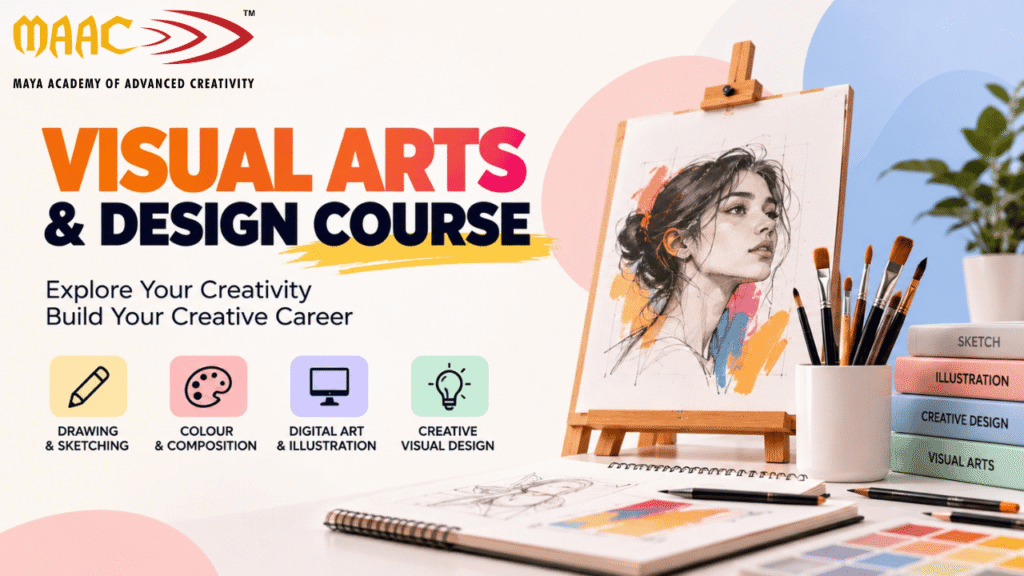
Visual arts and design involve communicating ideas, emotions, information, and stories through visual elements. These may include lines, shapes, colours, textures, images, illustrations, typography, and composition.
Visual arts often focuses on creating and interpreting artistic work, while design applies creative principles to solve communication or presentation problems.
For example, an artist may create an illustration to express an idea or emotion. A designer may use illustration, typography, and colour to communicate a product’s benefits to a specific audience.
Although the objectives can differ, the two areas overlap in many creative projects.
Visual arts and design can include:
Drawing and sketching
Painting and colour exploration
Digital illustration
Graphic design
Visual storytelling
Composition and layout
Character and environment concepts
Image editing
Creative advertising
Art direction fundamentals
A structured course can help students understand these areas before deciding which creative specialization they want to pursue.
Students looking for creative education often want to combine artistic interests with practical skills that can be applied in professional environments.
A visual arts and design course can help learners develop a stronger understanding of how visual ideas are created, refined, and presented.
Potential benefits include:
Creative skill development: Learn the fundamentals of drawing, composition, colour, and visual communication.
Digital design exposure: Explore software used for illustration, image editing, and graphic design, depending on the syllabus.
Practical project experience: Apply design principles to posters, illustrations, visual concepts, and other creative assignments.
Portfolio development: Build a collection of original work that demonstrates your creative thinking and technical skills.
Specialization opportunities: Explore related fields such as graphic design, digital illustration, concept art, or animation.
Career exploration: Understand the types of creative roles available and the skills they may require.
When choosing a course in Hyderabad, students should compare the curriculum, practical training, trainer support, software coverage, and portfolio-development opportunities rather than relying only on the course name.
A visual arts and design program may suit students from different educational backgrounds, subject to the institute’s eligibility criteria.
It may be relevant for:
Students after completing 12th
College students
Graduates interested in creative careers
Aspiring graphic designers
Drawing and illustration enthusiasts
Digital art beginners
Students interested in animation
Content creators
Advertising and marketing aspirants
Professionals exploring creative skills
Previous experience can be helpful, but beginners can start with fundamental drawing and design principles.
A willingness to observe, experiment, accept feedback, and practise consistently is often more important than having advanced skills at the beginning.
A strong visual arts and design curriculum should teach both artistic fundamentals and practical design techniques.
Drawing helps students translate ideas into visual form. It can improve observation, proportion, shape recognition, and the ability to communicate concepts through sketches.
Students may practise:
Basic shapes and forms
Line quality
Proportion
Object studies
Perspective fundamentals
Light and shadow
Gesture drawing
Composition sketches
These exercises can help students build confidence before progressing to more complex artwork.
Colour plays an important role in visual communication. It can establish mood, create contrast, organize information, and influence how viewers interpret a design.
Students can explore:
Primary and secondary colours
Colour relationships
Warm and cool colours
Complementary combinations
Contrast
Colour harmony
Colour psychology in design
Applying colour theory to practical projects can help students create more deliberate and effective visual compositions.
Composition refers to how visual elements are arranged within a frame or page.
A well-organized composition helps direct attention and create balance.
Students can learn about:
Balance
Alignment
Contrast
Proximity
Repetition
Negative space
Visual hierarchy
Focal points
These principles are useful in illustration, poster design, digital artwork, and other creative projects.
Perspective helps artists represent depth and spatial relationships.
Students may explore one-point and two-point perspective, basic object construction, overlapping forms, and the use of light and shadow to communicate volume.
These skills can support illustration, environment concepts, product visualization, and other forms of visual development.
Visual storytelling uses images, composition, colour, and visual sequences to communicate an idea.
Students can practise telling a story through a single illustration, a poster, a series of images, or a visual concept board.
This skill can be valuable in advertising, publishing, animation, digital content, and entertainment.
Visual arts can be explored through both traditional and digital methods.
Traditional art uses physical materials such as pencils, charcoal, markers, paints, and paper.
It helps students understand:
Hand-drawing techniques
Material handling
Texture
Shading
Colour mixing
Physical composition
Traditional practice can strengthen observation and artistic confidence.
Digital art is created using computers, tablets, and suitable software.
Students may learn:
Digital brushes
Layers
Masks
Colour adjustment
Digital sketching
Illustration workflows
Image compositing
Digital tools make it easier to revise artwork, experiment with colour, and create multiple versions of a concept.
Both approaches can be valuable. The right balance depends on the course curriculum and the student’s career interests.
The software covered in a visual arts program depends on its specialization. Students should verify the actual tools included before enrolling.
Photoshop is widely used for image editing, photo manipulation, digital painting, compositing, and raster artwork.
Students may use it to create digital illustrations, concept artwork, advertising visuals, and image-based compositions.
Illustrator is used for vector graphics, logos, icons, illustrations, and scalable artwork.
It is particularly useful when visual elements need to remain clear at different sizes.
InDesign is designed for page layout and publishing.
It can be used to arrange artwork, text, and images into brochures, magazines, portfolios, and other multi-page documents.
Depending on the curriculum, students may explore other drawing or painting applications that support digital brushes, layers, and illustration workflows.
Some programs may introduce software for animation, 3D design, or multimedia production. These should be considered additional specializations rather than assumed parts of every visual arts course.
The objective is to understand the creative process and select the right tool for each task.
Visual arts and graphic design are closely related, but they are not identical.
Visual arts often emphasizes artistic expression, drawing, illustration, experimentation, and visual exploration.
Graphic design focuses more directly on communicating information or messages through layouts, typography, images, and branding.
For example, a visual artist may create an original digital illustration. A graphic designer may use that illustration in a poster alongside a headline, supporting text, and branding elements.
Students interested in both areas can benefit from learning the fundamentals of art and then applying them to practical design problems.
A combined skill set can support work across illustration, advertising, publishing, digital content, and visual communication.
Practical projects help students move from learning principles to applying them independently.
Create a series of drawings based on everyday objects.
Focus on proportion, shape, perspective, shading, and composition.
Create several compositions using different colour relationships.
Compare how colour choices influence mood, contrast, and visual emphasis.
Develop an original illustration using a digital drawing or image-editing application.
Show the initial sketch, colour development, and final artwork.
Create a poster for a fictional event, product, or campaign.
Include a clear visual concept, suitable typography, supporting information, and a strong focal point.
Develop an original character using reference research, silhouette exploration, expressions, and colour variations.
This can help students interested in illustration, animation, or concept art.
Create an illustration that supports an article, story, or publication topic.
The artwork should communicate the intended idea while fitting the editorial context.
Develop a set of illustrations for a fictional brand.
Explore how visual style, colour, and shape can remain consistent across different applications.
Visual arts and design can provide a foundation for several creative career paths. Specific roles may require further specialization, advanced software skills, or additional training.
Creates visual assets for communication, marketing, and digital projects.
Produces original artwork for books, editorial content, advertising, products, and digital platforms.
Develops posters, advertisements, branding materials, layouts, and other visual communication assets.
Creates artwork using digital tools for personal, commercial, or entertainment projects.
Develops visual concepts for characters, environments, objects, or scenes. These positions often require specialized drawing and design skills.
Contributes visual ideas and artwork for promotional campaigns and marketing materials.
Combines text and imagery into structured publications such as brochures, magazines, and reports.
Provides creative services directly to businesses, agencies, publishers, and individual clients.
Career options depend on the student’s portfolio, technical strengths, chosen specialization, and the requirements of employers or clients.
Yes. Visual arts fundamentals can support further learning in animation and multimedia, although additional training is usually required.
Drawing, composition, colour, perspective, and storytelling are relevant to many animation workflows.
Students interested in animation may later explore:
Character design
Storyboarding
2D animation
3D modelling
Motion graphics
Visual effects
Environment design
Each specialization has its own technical requirements.
For example, character design requires strong drawing and visual-development skills, while 3D animation involves understanding modelling, rigging, movement, and production workflows.
A visual arts course can provide a useful foundation, but students should check whether animation and multimedia software are included in the specific program they are considering.
A portfolio is one of the most important ways to demonstrate creative ability.
It should show not only finished artwork but also the thought process behind selected projects.
A student portfolio may include:
Observational drawings
Colour studies
Digital illustrations
Posters
Editorial artwork
Character concepts
Brand illustrations
Personal creative projects
For each project, include a short explanation of the brief, the concept, the tools used, and the final outcome.
Where relevant, show sketches or early versions alongside the final artwork.
This can help reviewers understand how you approach problems and develop ideas.
Show your strongest work first. A focused portfolio is often more effective than a large collection of unrelated exercises.
Include different types of projects. Demonstrate a range of skills without sacrificing consistency.
Explain your process. Show how research, sketches, and experimentation contributed to the final result.
Use original work. Tutorials can help you learn, but your portfolio should demonstrate your own decisions and ideas.
Update it regularly. Replace older work as your skills improve.
Students who have completed 12th can explore visual arts and design as a potential starting point for creative education.
A suitable learning path may include:
Drawing and observation
Colour theory and composition
Design fundamentals
Digital art and illustration
Image editing and vector graphics
Practical creative projects
Portfolio development
Further specialization
Students should check the eligibility criteria, duration, syllabus, and qualification offered by the institution.
If your long-term goal is animation, game art, graphic design, or multimedia, choose a course that provides a foundation relevant to that direction.
When comparing a visual arts and design course in Hyderabad, consider the following factors.
Check whether the course includes drawing, colour theory, composition, digital illustration, software training, and practical projects.
Ask how students practise the concepts they learn and how assignments are evaluated.
Constructive feedback can help students identify weaknesses and improve their artistic skills.
Where possible, look at student portfolios and completed projects to understand the standard of practical training.
Check which applications are taught and whether students receive sufficient hands-on practice.
Ask whether the course includes original projects, portfolio reviews, and guidance on presenting creative work.
Confirm fees, duration, eligibility, class format, certificate details, and any career-support services offered.
A good course should help students understand design fundamentals, practise consistently, and develop work that demonstrates their abilities.
Creative tools are useful, but strong artwork also depends on composition, observation, colour, and visual communication.
Students who practise drawing, perspective, and colour theory often have a stronger foundation for more advanced work.
Reference images can be useful for learning, but students should gradually develop their own concepts and solutions.
Reviewing work critically and accepting constructive suggestions can help improve results.
Completing a smaller number of thoughtful projects can be more valuable than starting many without refining them.
Artwork should be organized clearly and displayed at a suitable resolution.
Developing professional-level skills takes time, consistent practice, and portfolio refinement.
Students can follow a structured approach to make steady progress.
Stage 1: Learn the Basics
Practise drawing, shapes, perspective, and observation.
Stage 2: Understand Design Principles
Explore colour, contrast, composition, balance, and visual hierarchy.
Stage 3: Develop Digital Skills
Learn suitable software for digital illustration, image editing, and vector artwork.
Stage 4: Complete Guided Projects
Create posters, illustrations, visual concepts, and other assignments.
Stage 5: Explore a Specialization
Choose an area such as graphic design, digital illustration, concept art, or animation fundamentals.
Stage 6: Develop a Portfolio
Select your strongest original projects and present them professionally.
Stage 7: Prepare for Career Opportunities
Research job requirements, refine your portfolio, and practise explaining your creative decisions.
This roadmap can be adapted to the student’s interests, learning pace, and course structure.
A visual arts and design course introduces creative principles such as drawing, colour theory, composition, visual storytelling, and design. Depending on the curriculum, it may also cover digital illustration and graphic design software.
Yes. Students who have completed 12th can explore relevant creative courses, subject to the eligibility requirements of the institution.
Not necessarily. Beginners can develop drawing and observation skills through structured practice. However, regular practice is important for improving artistic ability.
Depending on the course, students may use Photoshop, Illustrator, digital painting applications, and other creative tools.
Potential directions include illustration, graphic design, digital art, visual design, publication design, and concept art. Some roles require additional specialized training.
Yes. Drawing, composition, colour, and storytelling can support animation learning. Students will still need to develop animation-specific technical skills.
Yes. A portfolio helps demonstrate creative ability, problem-solving, technical skills, and personal style.
Compare the syllabus, practical assignments, software coverage, trainer guidance, portfolio development, eligibility, and course details before enrolling.
Yes. Freelance opportunities may include illustration, digital artwork, graphic design, and other creative services. Finding clients depends on the quality of your work, specialization, communication, and business skills.
Visual arts often emphasizes artistic expression and visual exploration, while graphic design focuses on communicating messages through structured visual elements. The fields overlap and can complement each other.